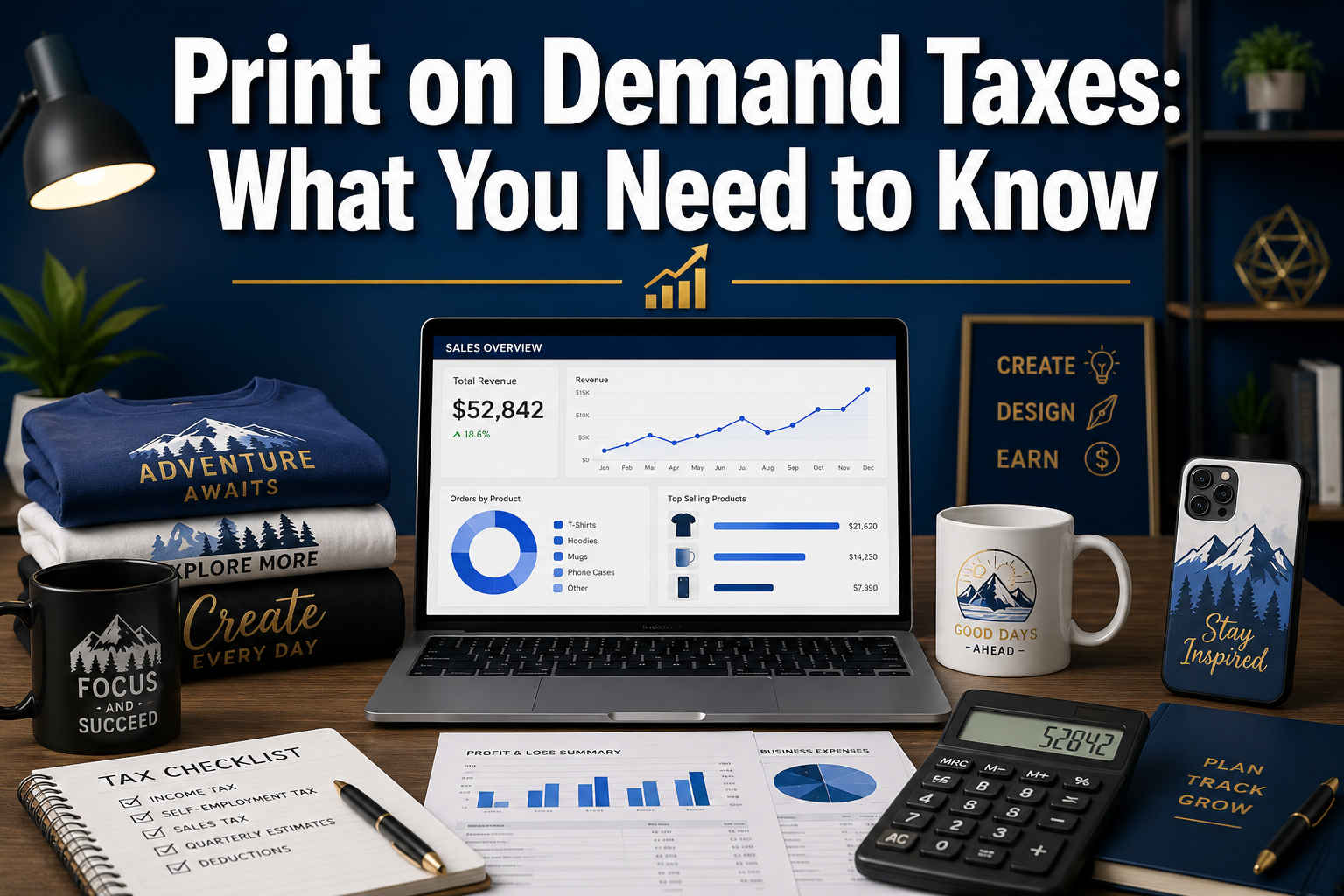
Understanding “Print on Demand Taxes: What You Need to Know” is crucial for any POD entrepreneur, as it involves navigating income tax on profits, sales tax obligations in various states, and managing deductible business expenses to ensure compliance and maximize profitability in 2026. Ignoring these responsibilities can lead to significant penalties and complications.
Key Takeaways:
- Print on demand businesses are subject to both income tax on net profits and, in many cases, sales tax on customer purchases.
- Sales tax collection depends on your business’s nexus, or significant presence, in a particular state.
- Proper registration for sales tax permits is essential before collecting sales tax, varying by state requirements.
- Common tax mistakes for POD sellers include neglecting nexus, failing to register for sales tax, and poor record-keeping.
- Many business expenses, such as software subscriptions, advertising, and home office costs, are deductible.
- Estimated taxes typically need to be paid quarterly if you expect to owe more than $1,000 in federal tax.
- International sales introduce complexities like VAT and customs duties, requiring careful planning.
- Utilizing accounting software is highly recommended for tracking all income and expenses efficiently.
- The legal structure (sole proprietorship vs. LLC) impacts how your POD income is reported for tax purposes.
- Even small amounts of income from POD are generally taxable and must be reported to the IRS.
What Are the Basic Tax Obligations for a Print on Demand Business?
For a print on demand business in 2026, the basic tax obligations primarily involve reporting and paying federal and state income taxes on your net profits, along with potentially collecting and remitting sales taxes on purchases made by customers. Additionally, self-employment taxes (Social Security and Medicare) are typically due if you operate as a sole proprietor or independent contractor.
Operating a POD business means you are effectively running a small business, regardless of scale. This brings a standard set of tax responsibilities:
- Income Tax: You must report all income earned from your POD sales and deduct eligible business expenses. Your net profit is then subject to federal and, if applicable, state income tax.
- Self-Employment Tax: If you’re a sole proprietor or single-member LLC, you’ll pay self-employment taxes, which cover Social Security and Medicare contributions, usually at a rate of 15.3% on your net earnings.
- Sales Tax: This is a consumption tax collected from customers at the point of sale and remitted to the state. Whether you need to collect it depends on your business’s “nexus” in various states.
- Estimated Taxes: If you expect to owe at least $1,000 in federal taxes for the year, you are generally required to pay estimated taxes quarterly rather than a lump sum at year-end.
Do I Need to Collect Sales Tax for Print on Demand, and Where?
Yes, you generally need to collect sales tax for print on demand if your business has sales tax nexus in a particular state where your customer resides. Sales tax nexus means your business has a significant enough presence in a state to be legally required to collect sales tax from customers in that state.
Understanding sales tax for a POD business can be complex because nexus isn’t always straightforward. Here’s a breakdown:
- Physical Nexus: This is the traditional definition, meaning you have a physical presence in a state. For a POD seller, this could include:
- Having an office or warehouse.
- Employing staff.
- Storing inventory (though POD often minimizes this, some platforms might consider their fulfillment centers as your inventory nexus).
- Having a sales representative or affiliate.
- Economic Nexus: Following the 2018 South Dakota v. Wayfair Supreme Court decision, many states now impose sales tax obligations based on economic activity, even without a physical presence. This typically means if your sales into a state exceed a certain dollar amount or number of transactions annually (e.g., $100,000 in sales or 200 separate transactions), you might establish economic nexus.
- Marketplace Facilitator Laws: Many POD platforms (like Etsy, Amazon Merch, Redbubble) are considered “marketplace facilitators.” In states with marketplace facilitator laws, the platform itself is responsible for calculating, collecting, and remitting sales tax on behalf of sellers. This significantly simplifies things for many POD entrepreneurs, but it’s crucial to verify your platform’s policy and the specific state laws.
- Origin vs. Destination-Based Sales Tax:
- Origin-based: Sales tax is calculated based on where your business operates (your physical location).
- Destination-based: Sales tax is calculated based on where your customer is located (the shipping address). Most states use destination-based sales tax for remote sellers.
Decision Rule: Always check the sales tax laws for each state where you have significant sales or a physical presence. If your platform acts as a marketplace facilitator, confirm which states they handle sales tax for. You are generally responsible for sales tax in states where your platform doesn’t cover it and you meet nexus thresholds.
What’s the Difference Between Income Tax and Sales Tax for POD Businesses?
The fundamental difference between income tax and sales tax for Print on Demand Taxes: What You Need to Know is that income tax is levied on your business’s profits, while sales tax is a consumption tax collected from the customer and passed on to the government.
- Income Tax:
- Who pays it: The business owner (you).
- What it’s based on: Your net profit after all allowable business expenses are deducted from your gross income.
- When it’s paid: Annually (with quarterly estimated payments if necessary).
- To whom: Federal government (IRS) and relevant state income tax authorities.
- Purpose: To fund government operations.
- Sales Tax:
- Who pays it: The end customer, though the business is responsible for collecting and remitting it.
- What it’s based on: The selling price of taxable goods or services.
- When it’s paid: Typically monthly, quarterly, or annually, depending on your sales volume and state requirements.
- To whom: State and sometimes local tax authorities.
- Purpose: To fund state and local government services.
How Do I Register for Sales Tax Permits in Different States?
To register for sales tax permits in different states, you must first identify where your print on demand business has sales tax nexus, and then apply directly to the Department of Revenue (or equivalent agency) in each of those states. This process typically involves providing your business information, including your Federal Employer Identification Number (EIN) or Social Security Number (SSN).
Here’s a step-by-step guide:
- Determine Nexus: Identify all states where your POD business has a physical presence or meets economic nexus thresholds for 2026. Remember to check if your marketplace facilitator (e.g., Etsy, Shopify with specific apps) is already handling sales tax in certain states.
- Locate State Tax Authority: Find the official website for the Department of Revenue or taxation office for each relevant state. A quick search for “[State Name] Department of Revenue sales tax registration” should lead you there.
- Complete Online Application: Most states offer an online application process. You’ll typically need:
- Your legal business name and address.
- Your EIN (recommended for all businesses) or SSN.
- Your business structure (sole proprietorship, LLC, etc.).
- The type of products you sell (e.g., “retail sales of tangible personal property”).
- The date you started or will start collecting sales tax.
- Receive Your Permit: After approval, the state will issue you a sales tax permit or license number. This permit legally authorizes you to collect sales tax.
- Understand Filing Frequency: Each state will assign you a filing frequency (e.g., monthly, quarterly, annually) based on your projected sales volume.
- Set Up Collection: Integrate your sales tax permit numbers into your e-commerce platform or accounting software to ensure correct sales tax calculation and collection.
Common Mistake: Many POD sellers mistakenly start collecting sales tax before registering for a permit. This is illegal. You must have a valid sales tax permit in hand before you begin charging customers sales tax in that state.
What Common Mistakes Do POD Sellers Make with Taxes?
Print on demand sellers often make several common tax mistakes, including neglecting sales tax nexus obligations, failing to register for required sales tax permits, poor record-keeping, and not paying estimated taxes. These errors can lead to penalties, audits, and significant financial stress.
Key mistakes to avoid:
- Ignoring Sales Tax Nexus: Assuming sales tax doesn’t apply because you operate from home. Many states now have economic nexus laws that require remote sellers to collect tax.
- Failing to Register for Permits: Collecting sales tax without a valid permit is illegal and can lead to fines. You must register in every state where you establish nexus and are not covered by a marketplace facilitator.
- Poor Record-Keeping: Not maintaining detailed records of income, expenses, and sales tax collected. This makes tax preparation difficult and puts you at a disadvantage during an audit.
- Not Paying Estimated Taxes: Underpaying or failing to pay estimated taxes throughout the year can result in penalties, especially for profitable businesses.
- Mixing Personal and Business Finances: Using personal bank accounts and credit cards for business transactions makes it incredibly hard to track deductions and accurately report income.
- Missing Deductions: Not being aware of or tracking eligible business expenses, which can lead to overpaying income tax.
- Incorrect Business Classification: Not choosing an appropriate legal structure (e.g., LLC) or not correctly reporting income based on your structure.
- Ignoring International Tax Implications: Failing to consider VAT, GST, or other international taxes when selling to customers outside your home country.
What Expenses Can I Deduct for My Print on Demand Business?
You can deduct many ordinary and necessary expenses incurred to run your print on demand business, which reduces your taxable income. Common deductions include platform fees, advertising costs, design software subscriptions, home office expenses, and internet service.
To be deductible, an expense must be both “ordinary” (common and accepted in your industry) and “necessary” (helpful and appropriate for your business). Here are common deductible expenses for a POD business:
- Platform Fees: Listing fees, transaction fees, subscription costs for POD platforms (e.g., Shopify, Etsy, Printful, Printify).
- Marketing and Advertising: Costs for social media ads, Google Ads, influencer marketing, website promotion.
- Software and Subscriptions: Design software (e.g., Adobe Creative Cloud), accounting software, email marketing tools, keyword research tools.
- Website and Domain Costs: Fees for your website domain, hosting, and any e-commerce theme or plugin purchases.
- Design Costs: Payments to freelance designers or for stock graphics and fonts.
- Home Office Deduction: If you exclusively and regularly use a portion of your home for business, you can deduct a portion of rent/mortgage, utilities, and insurance (simplified option or actual expenses).
- Internet and Phone: A portion of your internet and phone bill if used for business.
- Bank Fees: Business bank account fees, credit card processing fees.
- Professional Services: Fees paid to accountants, tax preparers, legal advisors.
- Education and Training: Costs for courses, workshops, or books related to improving your POD business skills.
- Supplies: Office supplies, packaging materials (if you handle any aspect of packaging).
- Travel: Business-related travel expenses, such as attending trade shows.
Example: If you pay $29/month for a design software subscription, $50/month for marketing ads, and $15/month for your e-commerce platform, these $94 in monthly expenses are fully deductible from your POD income.
When Do I Need to Start Paying Estimated Taxes for My POD Income?
You need to start paying estimated taxes for your print on demand income if you expect to owe at least $1,000 in federal income tax for the year. These payments are made quarterly to cover your income tax and self-employment tax obligations.
The U.S. tax system operates on a “pay-as-you-go” basis. Since POD businesses often don’t have taxes withheld from their earnings (like a traditional W2 job), business owners are responsible for estimating and paying their taxes directly.
- Threshold: If you anticipate owing $1,000 or more in federal tax when you file your annual return, you’re generally required to make estimated tax payments.
- Payment Schedule (for 2026):
- Q1 (Jan 1 to Mar 31): Due April 15
- Q2 (Apr 1 to May 31): Due June 15
- Q3 (Jun 1 to Aug 31): Due Sept 15
- Q4 (Sept 1 to Dec 31): Due Jan 15 of the following year
- How to Pay: You can pay estimated taxes online via IRS Direct Pay, through EFTPS (Electronic Federal Tax Payment System), or by mail with Form 1040-ES vouchers.
- Calculating Payments: You can estimate your total income and deductions for the year, then divide the anticipated tax liability by four. Alternatively, you can base payments on your previous year’s tax liability to avoid penalties (safe harbor rules).
- State Estimated Taxes: Many states also require estimated tax payments if you anticipate owing a certain amount of state income tax. Check your state’s specific requirements.
Common Mistake: Many new POD sellers are unaware of estimated taxes, leading to a large tax bill and potential penalties at tax time.
What If I’m Selling Internationally, How Do Taxes Work Then?
Selling internationally with a print on demand business introduces additional tax considerations, primarily revolving around Value Added Tax (VAT) in Europe, Goods and Services Tax (GST) in places like Canada and Australia, and understanding international shipping and customs duties.
Here’s how taxes work when selling internationally:
- VAT (Value Added Tax) / GST (Goods and Services Tax):
- These are consumption taxes levied in many countries outside the U.S.
- If you sell to customers in countries with VAT/GST, you may be required to register, collect, and remit these taxes, especially if your sales exceed certain thresholds.
- Marketplace Facilitators: Many POD platforms will handle VAT/GST collection for sales to certain countries (e.g., EU, UK, Australia) on behalf of sellers, significantly simplifying compliance. Always verify your platform’s policy.
- Direct Sales: If you sell directly (e.g., through your own Shopify store without a marketplace facilitator handling it), you are typically responsible for understanding and complying with each country’s specific VAT/GST rules, including registration and remittance.
- Customs Duties and Import Taxes:
- These are taxes imposed on goods imported into a country.
- For POD products, these are usually paid by the customer upon delivery, often managed by the shipping carrier.
- It’s crucial to clearly communicate to international customers that they may be responsible for these additional charges to avoid surprises and negative reviews.
- Income Tax in Other Countries: Generally, as a U.S.-based POD seller, your income is taxed by the U.S. government. You typically won’t owe income tax to other countries unless you establish a “permanent establishment” (a significant physical presence) there, which is rare for most online POD businesses.
- Tax Treaties: The U.S. has tax treaties with many countries designed to prevent double taxation.
Edge Case: If you use a POD fulfillment partner based in an international country to serve customers in that region, it could potentially create a physical nexus for sales tax or VAT purposes in that country, requiring careful review.
Are There Any Specific Tax Benefits or Credits for Small Online Businesses Like POD?
While there aren’t many specific tax benefits exclusively for print on demand businesses, small online businesses, including POD operations, can take advantage of various general business deductions and a few targeted tax credits that reduce their overall tax liability.
- Standard Business Deductions: As detailed above, nearly all legitimate business expenses are deductible, significantly lowering your net taxable income. This is the primary “benefit” for most small businesses.
- Qualified Business Income (QBI) Deduction (Section 199A): Eligible self-employed individuals and owners of pass-through entities (sole proprietors, partnerships, S-corps) can deduct up to 20% of their qualified business income. This is a significant deduction for many POD sellers. Income limitations and other rules apply.
- Home Office Deduction: Allows you to deduct expenses related to the business use of your home.
- Self-Employed Health Insurance Deduction: If you pay for your own health insurance and aren’t eligible for an employer-sponsored plan, you can deduct those premiums.
- Retirement Plan Contributions: Contributions to self-employed retirement plans like a SEP IRA or Solo 401(k) are tax-deductible and a powerful way to save for retirement while reducing current taxable income.
- Small Business Health Care Tax Credit: This credit is for small employers who pay at least half the cost of health insurance premiums for their employees. Most single-person POD businesses won’t qualify.
- Research and Development (R&D) Tax Credit: While typically associated with larger, more traditional businesses, very innovative POD businesses that develop truly new processes or products might qualify. This is rare.
Recommendation: Focus on maximizing legitimate business expense deductions and exploring the QBI deduction and self-funded retirement plans, as these offer the most common and substantial tax benefits for most POD entrepreneurs.
What Accounting Software Is Best for Tracking POD Income and Expenses for Tax Purposes?
The best accounting software for tracking print on demand income and expenses for tax purposes is generally one that integrates well with your sales platforms, simplifies expense categorization, and can generate accurate financial reports. Popular choices include QuickBooks Self-Employed, FreshBooks, and Wave Accounting.
Key features to look for:
- Integration with Sales Channels: The ability to connect directly with platforms like Shopify, Etsy, or even your bank accounts to automatically import transactions.
- Expense Tracking: Features for categorizing expenses, ideally with options for attaching receipts.
- Income Tracking: Tools to record all sales, including those from multiple POD platforms.
- Reporting: Capability to generate profit & loss statements, balance sheets, and reports useful for tax preparation.
- Mileage Tracking: If you travel for business (e.g., to the post office or for supplies).
- Estimated Tax Calculation: Some software can help you estimate your quarterly tax payments.
Comparison Table: Accounting Software for POD
| Software Name | Best For | Key Features | Pricing Model |
|---|---|---|---|
| QuickBooks Self-Employed | Freelancers, Sole Proprietors, Simple Needs | Income/expense tracking, mileage tracking, estimated tax calculations, receipt capture, basic reporting. | Monthly (Paid) |
| FreshBooks | Service-based businesses, Freelancers | Invoicing, expense tracking, project management, time tracking, basic reporting. | Monthly (Paid) |
| Wave Accounting | Small businesses on a budget | Free accounting software, invoicing, income/expense tracking, basic reporting. | Free (Paid add-ons) |
| Xero | Growing businesses, more robust features | Comprehensive accounting, bank reconciliation, multi-currency, payroll integration. | Monthly (Paid) |
Recommendation: For most new or small POD sellers, QuickBooks Self-Employed or Wave Accounting (if budget is a concern) are excellent starting points due to their ease of use and features tailored for self-employed individuals.
What’s the Tax Impact of Using Different Print on Demand Platforms?
The tax impact of using different print on demand platforms primarily revolves around how they handle sales tax collection and reporting, and the fees they charge, which affect your deductible expenses and ultimately your net income.
- Sales Tax Collection:
- Marketplace Facilitators: Platforms like Etsy, Amazon Merch on Demand, Redbubble, and others often act as “marketplace facilitators.” In states with marketplace facilitator laws, these platforms are legally obligated to collect and remit sales tax on your behalf. This significantly simplifies your sales tax obligations for sales made through them in those states.
- Direct Sales (e.g., Shopify + POD App): If you use a platform like Shopify and integrate with a POD fulfillment app (e.g., Printful, Printify), Shopify itself may not automatically collect sales tax for all states. You would typically use Shopify’s built-in tax settings or a third-party sales tax app to configure collection in states where you have nexus. In this scenario, you are usually responsible for remitting the collected sales tax.
- Fee Structures: Different platforms have varying fees (listing fees, transaction fees, subscription fees, payment processing fees). All these fees are legitimate business expenses and are deductible, reducing your taxable income.
- Income Reporting: All platforms should provide you with a summary of your earnings. In the U.S., if a platform pays you over a certain threshold (historically $20,000 and 200 transactions, though this threshold has been in flux and is $5,000 for 2024 for 1099-K reporting), they typically issue a Form 1099-K or other relevant tax form. Even if you don’t receive a form, you must report all income.
- Payment Processors: Platforms often use third-party payment processors (e.g., PayPal, Stripe). These processors also have reporting thresholds and may issue 1099-K forms based on your transaction volume.
Key Takeaway: Always review each POD platform’s tax documentation and terms of service to understand their role in sales tax collection and their income reporting practices for 2026. This will directly impact your “Print on Demand Taxes: What You Need to Know.”
How Does a Sole Proprietorship Handle POD Taxes Versus an LLC?
A sole proprietorship handles Print on Demand taxes by reporting business income and expenses directly on the owner’s personal Form 1040 (Schedule C), whereas an LLC offers more flexibility, allowing it to be taxed as a sole proprietorship (default for single-member LLCs), partnership, or even a corporation, impacting how income and expenses are reported.
- Sole Proprietorship:
- Simplicity: This is the easiest structure to set up, requiring no formal registration beyond local business licenses.
- Tax Reporting: Your POD business income and expenses are reported on Schedule C (Profit or Loss From Business), which is attached to your personal Form 1040.
- Pass-Through Taxation: Business profits (or losses) “pass through” directly to your personal tax return. The business itself is not separately taxed.
- Self-Employment Tax: You pay self-employment tax (Social Security and Medicare) on your net earnings from the business.
- Liability: You have unlimited personal liability for business debts and obligations.
- Limited Liability Company (LLC):
- Legal Protection: The primary benefit of an LLC is that it provides a legal shield, protecting your personal assets from business debts and lawsuits.
- Tax Reporting Flexibility: This is where LLCs differ significantly:
- Single-Member LLC (default): Automatically taxed as a sole proprietorship. You report income and expenses on Schedule C, just like a sole proprietor.
- Multi-Member LLC (default): Automatically taxed as a partnership. The LLC files Form 1065 (U.S. Return of Partnership Income), and each owner receives a Schedule K-1 detailing their share of income/losses to report on their personal Form 1040.
- LLC Taxed as an S-Corp: An LLC can elect to be taxed as an S-corporation. This can potentially save on self-employment taxes because owners can pay themselves a “reasonable salary” (subject to payroll taxes) and take the remaining profits as distributions (not subject to self-employment tax). This is more complex and typically recommended for businesses with significant profits.
- LLC Taxed as a C-Corp: Less common for POD businesses due to double taxation, where the corporation pays tax on its profits, and shareholders pay tax again on dividends.
Decision Rule: For most new POD sellers, starting as a sole proprietorship (or a single-member LLC taxed as a sole proprietorship for liability protection) is the simplest approach to “Print on Demand Taxes: What You Need to Know.” As your business grows and profits increase, exploring the S-Corp election for an LLC might offer tax advantages.
What If I Only Make a Small Amount of Money From Print on Demand, Do I Still Owe Taxes?
Yes, if you only make a small amount of money from print on demand, you generally still owe taxes, as all income, regardless of the amount, must be reported to the IRS. The common rule is that if your net earnings from self-employment are $400 or more, you must file a tax return and pay self-employment taxes.
Even if you don’t meet the $400 self-employment threshold, any income you earn from POD is considered taxable income.
- Reporting All Income: The IRS expects you to report all income you receive, even if you don’t receive a Form 1099-K or other tax forms from your platforms. This includes income from hobbies, side hustles, and small businesses.
- Self-Employment Tax Threshold: While all income is reportable, the specific requirement to pay self-employment tax (Social Security and Medicare) kicks in when your net earnings from self-employment are $400 or more.
- No Income Tax if Below Standard Deduction: If your total income (including POD income and any other income) is below the standard deduction amount for your filing status, you might not owe federal income tax, but you would still owe self-employment tax if your net POD earnings exceed $400.
- Net Earnings Matter: Remember, it’s your net earnings (total income minus all allowable business expenses) that determine your tax liability. Even if you have high gross sales, if your expenses are also high, your net taxable income could be low.
Example: If your POD business generates $800 in gross sales but has $500 in deductible expenses (platform fees, design software), your net earnings are $300. In this scenario, you would still report the $300 income but would not owe self-employment tax, though it contributes to your overall taxable income. If your net earnings were $450, you would owe self-employment tax on that amount.
Where Can I Find a Good Tax Professional Who Understands Print on Demand Businesses?
To find a good tax professional who understands print on demand businesses, look for CPAs (Certified Public Accountants) or EAs (Enrolled Agents) specializing in e-commerce, small business taxation, or online retail. Referrals from other POD sellers and professional organizations can also be valuable resources.
Here are some strategies for finding the right professional for your “Print on Demand Taxes: What You Need to Know”:
- Ask for Referrals: Connect with other print on demand sellers or e-commerce entrepreneurs in online forums, social media groups, or local business networks. They can often recommend tax professionals who are familiar with the unique aspects of online retail.
- Search Online Directories:
- AICPA (American Institute of CPAs) CPA Directory: Allows you to search for CPAs by specialty.
- National Association of Enrolled Agents (NAEA): EAs are federally licensed tax practitioners who specialize in taxation.
- Local CPA Firms: Many smaller firms advertise specialties in small business or e-commerce.
- Look for E-commerce Expertise: When researching, specifically look for phrases like “e-commerce tax,” “online seller taxes,” “small business accounting,” or “digital business tax specialist.”
- Interview Candidates: Don’t hesitate to interview a few tax professionals. Ask questions about their experience with:
- Online businesses and digital products.
- Sales tax nexus issues across multiple states.
- Marketplace facilitator laws.
- International sales and VAT/GST.
- Managing platform fees and digital expenses.
- Consider a Virtual Professional: Given the online nature of POD, a tax professional doesn’t necessarily need to be local. Many excellent e-commerce tax specialists work virtually.
Conclusion
Navigating “Print on Demand Taxes: What You Need to Know” is an essential part of running a successful and compliant online business in 2026. While the landscape of income tax, sales tax, and deductions can seem daunting, understanding your obligations and proactively managing your financial records can prevent future headaches and penalties. Every print on demand entrepreneur must grasp the distinction between income and sales taxes, diligently track expenses for potential deductions, and be aware of nexus rules for sales tax collection, especially with marketplace facilitator laws.
Actionable Next Steps:
- Assess Your Nexus: Review your sales data for 2026 to determine if you have met economic nexus thresholds in any new states, in addition to any physical nexus.
- Verify Platform Tax Handling: Confirm which sales tax obligations your POD platforms (e.g., Etsy, Amazon) are handling for you in various states.
- Register for Permits: If you have nexus in states not covered by a marketplace facilitator, register for the necessary sales tax permits before collecting tax.
- Implement Accounting Software: Start using dedicated accounting software to meticulously track all income and deductible expenses.
- Plan for Estimated Taxes: If your business is profitable, set aside funds and prepare to make quarterly estimated tax payments to the IRS and your state tax authority.
- Consult a Professional: For complex situations, particularly involving international sales or significant growth, seek advice from a tax professional specializing in e-commerce.
By taking these steps, you can ensure your print on demand business remains financially healthy and fully compliant with all tax regulations.

Share this:

Discover more from Fahza Enterprise
Subscribe to get the latest posts sent to your email.